AFTER THE IT BAG
The bag has always been more than a practical object. For decades, it was one of fashion’s clearest status signals: instantly recognizable shapes, logos and hardware designed to communicate belonging. To know the bag was to know the brand, the price, the world it represented.
But that language is beginning to change.
The next generation is less interested in carrying a symbol of belonging than a symbol of difference. Recognition is no longer always the goal. In fact, the coolest bag in the room may be the one nobody can identify.
The old question was “What bag is that?” meaning: which brand is it? The new question is simply: “What is that?”
That distinction matters. It suggests that the bag is shifting from status object to identity object. Instead of proving access to an established hierarchy, it becomes a way of constructing a personal visual language: something rare, strange, difficult to categorize, perhaps made in small numbers or by a designer whose name is not yet universally known.
The desire has not disappeared. It has become more individual. What carries value now is not necessarily recognizability, but discovery, rarity and the feeling that an object belongs specifically to the person carrying it rather than to an existing uniform of luxury.
For a long time, the idea of the “It bag” depended on consensus. A bag became desirable because everyone agreed that it was desirable. Its cultural power increased with visibility. Celebrities carried it, magazines photographed it, waiting lists formed around it, and eventually its silhouette alone became enough to communicate what it was.
There is something almost contradictory happening now. Visibility can make an object less interesting. When an image has been repeated thousands of times, when the same bag appears on every feed and is immediately recognizable from across a room, familiarity begins to work against desire.
For people interested in fashion as a form of self-definition, ubiquity is no longer necessarily aspirational.
The attraction increasingly lies elsewhere: in the object you have never seen before, the unknown designer, the impossible construction, the piece that appears to have escaped from another discipline entirely.
This is where the bag becomes interesting again.
Unlike clothing, a bag does not need to negotiate with the body in quite the same way. It can become rigid, architectural, exaggerated, asymmetrical, even slightly absurd, while remaining functional. It can sit somewhere between accessory, sculpture, engineering experiment and personal object.
And perhaps this is why the bag is becoming one of the most fertile spaces in fashion for experimentation.
Once the expectation of immediate brand recognition begins to disappear, the object is free to become stranger.
A handle does not have to look like a handle. A seam does not necessarily have to be sewn. The structure does not need to reproduce construction methods that have existed for generations. Proportions can become uncomfortable, exaggerated or unfamiliar. Hardware can stop being decorative and become structural. The bag can begin to develop its own anatomy.
This is the territory I have become increasingly interested in.
I did not want to approach bags simply by designing another shape within an existing vocabulary. I became much more interested in questioning how the object itself is constructed.
My work has always moved between leather, metal, rubber, clothing and objects, so approaching the bag as a fixed category never felt particularly useful. I wanted to treat it as a structure.
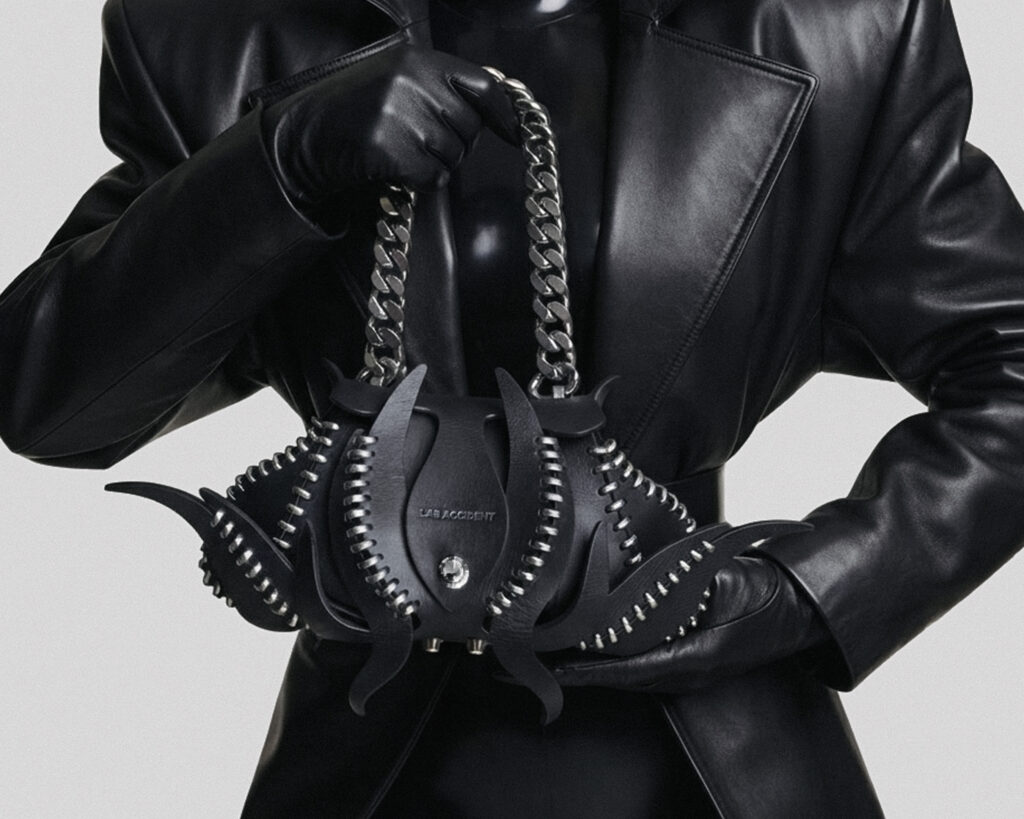
The new pieces I am developing are constructed through the LAB ACCIDENT Metal Stitch™ method, where sections of leather are joined through solid stainless-steel elements rather than conventional thread stitching. What began as a construction method in my earlier work has gradually become a way of thinking about form itself.
Removing the traditional seam changes more than the technique.
It changes what the leather is able to become.
The metal connections allow the structure to remain visible rather than disguised inside the object. Instead of trying to make construction disappear, I want it to become part of the visual language of the bag. The point where two surfaces meet becomes something deliberate, almost mechanical. Structure becomes ornament without being decorative.
This opens the possibility of building bags with increasingly complex shapes, volumes and tensions: pieces that remain completely functional but begin to occupy the space of an art object.
And I think this corresponds to a larger change in what people are beginning to want from fashion.
We have spent decades being taught to desire objects because they were recognizable.
Perhaps the next phase is about objects that resist recognition.
Not anonymous objects, and not objects without identity. Quite the opposite. Objects with so much identity that they cannot easily be reduced to a logo, a category or a reference everyone already understands.
There is a particular pleasure in wearing or carrying something that creates a moment of confusion.
Something that makes another person look twice.
Something that cannot immediately be placed.
“What brand is that?” belongs to one era of fashion.
“What is that?” may belong to the next.
And for me, that is where the bag becomes interesting again: not as a miniature billboard for an existing idea of luxury, but as a strange, functional object capable of carrying an identity of its own.
AFTER THE IT BAG
The bag has always been more than a practical object. For decades, it was one of fashion’s clearest status signals: instantly recognizable shapes, logos and hardware designed to communicate belonging. To know the bag was to know the brand, the price, the world it represented.
But that language is beginning to change.
The next generation is less interested in carrying a symbol of belonging than a symbol of difference. Recognition is no longer always the goal. In fact, the coolest bag in the room may be the one nobody can identify.
The old question was “What bag is that?” meaning: which brand is it? The new question is simply: “What is that?”
That distinction matters. It suggests that the bag is shifting from status object to identity object. Instead of proving access to an established hierarchy, it becomes a way of constructing a personal visual language: something rare, strange, difficult to categorize, perhaps made in small numbers or by a designer whose name is not yet universally known.
The desire has not disappeared. It has become more individual. What carries value now is not necessarily recognizability, but discovery, rarity and the feeling that an object belongs specifically to the person carrying it rather than to an existing uniform of luxury.
For a long time, the idea of the “It bag” depended on consensus. A bag became desirable because everyone agreed that it was desirable. Its cultural power increased with visibility. Celebrities carried it, magazines photographed it, waiting lists formed around it, and eventually its silhouette alone became enough to communicate what it was.
There is something almost contradictory happening now. Visibility can make an object less interesting. When an image has been repeated thousands of times, when the same bag appears on every feed and is immediately recognizable from across a room, familiarity begins to work against desire.
For people interested in fashion as a form of self-definition, ubiquity is no longer necessarily aspirational.
The attraction increasingly lies elsewhere: in the object you have never seen before, the unknown designer, the impossible construction, the piece that appears to have escaped from another discipline entirely.
This is where the bag becomes interesting again.
Unlike clothing, a bag does not need to negotiate with the body in quite the same way. It can become rigid, architectural, exaggerated, asymmetrical, even slightly absurd, while remaining functional. It can sit somewhere between accessory, sculpture, engineering experiment and personal object.
And perhaps this is why the bag is becoming one of the most fertile spaces in fashion for experimentation.
Once the expectation of immediate brand recognition begins to disappear, the object is free to become stranger.
A handle does not have to look like a handle. A seam does not necessarily have to be sewn. The structure does not need to reproduce construction methods that have existed for generations. Proportions can become uncomfortable, exaggerated or unfamiliar. Hardware can stop being decorative and become structural. The bag can begin to develop its own anatomy.
This is the territory I have become increasingly interested in.
I did not want to approach bags simply by designing another shape within an existing vocabulary. I became much more interested in questioning how the object itself is constructed.
My work has always moved between leather, metal, rubber, clothing and objects, so approaching the bag as a fixed category never felt particularly useful. I wanted to treat it as a structure.
The new pieces I am developing are constructed through the LAB ACCIDENT Metal Stitch™ method, where sections of leather are joined through solid stainless-steel elements rather than conventional thread stitching. What began as a construction method in my earlier work has gradually become a way of thinking about form itself.
Removing the traditional seam changes more than the technique.
It changes what the leather is able to become.
The metal connections allow the structure to remain visible rather than disguised inside the object. Instead of trying to make construction disappear, I want it to become part of the visual language of the bag. The point where two surfaces meet becomes something deliberate, almost mechanical. Structure becomes ornament without being decorative.
This opens the possibility of building bags with increasingly complex shapes, volumes and tensions: pieces that remain completely functional but begin to occupy the space of an art object.
And I think this corresponds to a larger change in what people are beginning to want from fashion.
We have spent decades being taught to desire objects because they were recognizable.
Perhaps the next phase is about objects that resist recognition.
Not anonymous objects, and not objects without identity. Quite the opposite. Objects with so much identity that they cannot easily be reduced to a logo, a category or a reference everyone already understands.
There is a particular pleasure in wearing or carrying something that creates a moment of confusion.
Something that makes another person look twice.
Something that cannot immediately be placed.
“What brand is that?” belongs to one era of fashion.
“What is that?” may belong to the next.
And for me, that is where the bag becomes interesting again: not as a miniature billboard for an existing idea of luxury, but as a strange, functional object capable of carrying an identity of its own.